

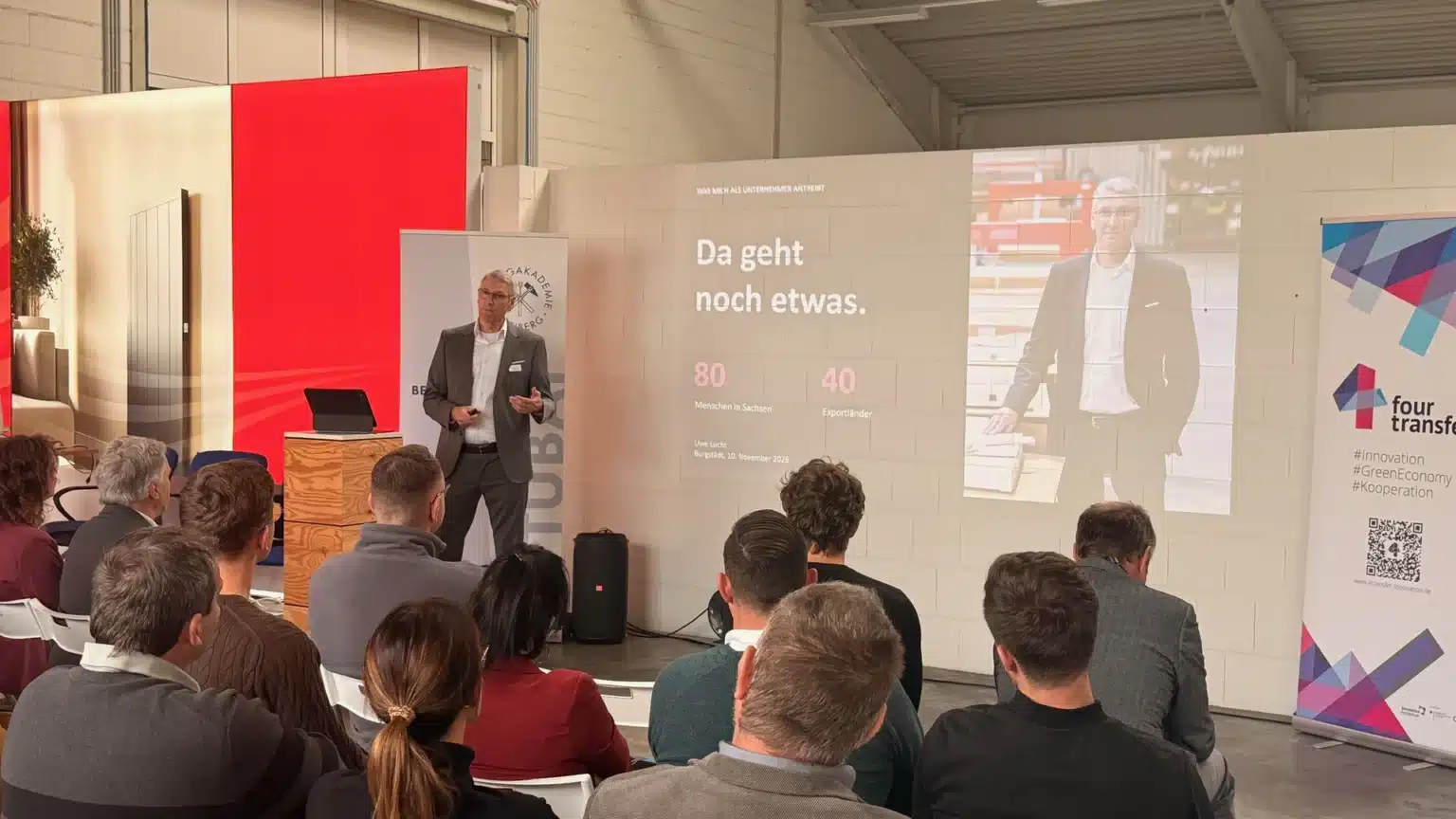
LUCHT LHZ intends to implement a project in Burgstädt over the coming years involving an autonomous logistics robot that will transport electric heaters and semi-finished products between company sites using public roads. On Tuesday, 10 November 2026, experts from the fields of science, industry, and public administration met in Burgstädt to discuss the technical, legal, and organisational requirements. The event was hosted by the IHK Chemnitz chamber of commerce and industry, the TU Bergakademie Freiberg university of mining and technology, and the 4transfer innovation network, in cooperation with LUCHT LHZ and the town of Burgstädt.
Specifically, an autonomous logistics robot at the LUCHT LHZ site will take responsibility for the entire flow of goods between the two Saxony-based electric heating manufacturer sites on the Burgstädt industrial estate. As the route crosses public roads, the robot will also need to be able to navigate safely and reliably outside the company premises in future. The 4transfer innovation network is working together with TU Bergakademie Freiberg and the relevant municipal and regional authorities to develop the necessary technical and organisational solutions. The project continues the pilot project for autonomous logistics launched in November 2025.
“With our emission-free electric heating systems, we are driving innovative solutions forward. We want to apply the same standard to our own processes. It is therefore extremely important to us as a company that we align our logistics processes with the future and make them scalable, for example with the help of an autonomous robot. This project also allows us to gain experience with a technology that could be of interest to other companies in Saxony and across Germany,” says Managing Director Uwe Lucht. He adds that, to achieve this, the technical requirements must first be put in place and it must be clarified with the relevant authorities how the robot can be deployed safely and lawfully in public traffic areas.
At the same time, the Burgstädt project is intended to serve as a real-world laboratory. The findings and solutions developed there will be transferred to further test sites in Saxony. This will help to strengthen the Free State’s position as a location for the development and testing of autonomous systems in public traffic areas.
Navigating safely in public traffic areas poses a particular challenge. Unlike in an enclosed factory, where they operate in a controlled environment, autonomous robots have to cope with a variety of road users, changing environmental conditions and unforeseeable situations. “The technical challenge lies in ensuring that the robot can move reliably and safely in an environment that cannot be fully controlled. This requires sensor technology, navigation and obstacle detection to work together perfectly. The technical foundations are in place. What matters now is testing them under real conditions and adapting them to the specific on-site requirements,” explains Prof. Sebastian Zug, Chair of Software Development and Robotics at TU Bergakademie Freiberg.
Representatives of robot manufacturers and user companies from the district of Mittelsachsen, as well as legal, regulatory and research experts, therefore discussed the current state of development and implementation of autonomous robots. The focus was on the prerequisites for their use in public traffic areas, and on how to bring together technical, legal and organisational requirements in practice.
The Burgstädt project demonstrates how collaboration between research institutions, industry and public administration enables new technologies to be tested in real-world scenarios and paves the way for their practical application. The experience gained is intended to facilitate the development of further applications for autonomous robots in public traffic areas.
About the Institute of Computer Science at TU Bergakademie Freiberg
One of the Institute of Computer Science’s research priorities is autonomous mobile systems. The focus is on compact outdoor robots, which are developed for a variety of applications and scenarios. Particular attention is paid to the robustness of the solutions, energy management, and interaction with people. In recent years, the institute has developed driving and swimming systems for national and international projects involving delivery tasks, ecosystem monitoring and data capture in underground environments. Research activities are closely integrated into the teaching of the corresponding Robotics degree programme.
You can find out more about TU Bergakademie Freiberg here: https://tu-freiberg.de/.
You can find out more about the Chair of Software Development and Robotics (Institute of Computer Science) here: https://tu-freiberg.de/soro.
About 4transfer
The 4transfer innovation network brings together science, industry, public administration and society in order to develop and test practical solutions to current challenges, such as the energy transition, technological change and resource scarcity. This close exchange ensures that innovative ideas directly impact society and that sustainable change becomes tangible. 4transfer is funded by the German federal and state initiative “Innovative Hochschule”. The network comprises TU Bergakademie Freiberg, Duale Hochschule Sachsen, Hochschule Meißen (FH), and Fortbildungszentrum, as well as Landesverband der Kultur- und Kreativwirtschaft Sachsen e.V.
Find out more about 4transfer at https://www.4transfer-innovation.de/.
About LUCHT LHZ
LUCHT LHZ is a family-run company with 40 years of experience in the production and development of electric heating systems. Its product portfolio includes infrared heaters, storage heaters and convector heaters. LUCHT LHZ manufactures all its heating appliances in Burgstädt and Hartmannsdorf from components produced entirely in Europe. The electric heaters are sold under the brand name TECHNOTHERM. LUCHT LHZ also produces electric heating systems as an OEM partner for companies in over 40 countries worldwide.


